<?xml version="1.0" encoding="utf-8"?><feed xmlns="http://www.w3.org/2005/Atom" ><generator uri="https://jekyllrb.com/" version="3.10.0">Jekyll</generator><link href="https://aeyocca.github.io/feed.xml" rel="self" type="application/atom+xml" /><link href="https://aeyocca.github.io/" rel="alternate" type="text/html" /><updated>2026-10-08T23:30:01+00:00</updated><id>https://aeyocca.github.io/feed.xml</id><title type="html">Alan E. Yocca</title><subtitle>Place for people to contact me / host procrastiblogging.</subtitle><author><name>Alan E. Yocca, PhD</name><email>aeyap42@gmail.com</email></author><entry><title type="html">Run PAUP with Docker</title><link href="https://aeyocca.github.io/PAUP_docker/" rel="alternate" type="text/html" title="Run PAUP with Docker" /><published>2024-12-12T00:00:00+00:00</published><updated>2024-12-12T00:00:00+00:00</updated><id>https://aeyocca.github.io/PAUP_docker</id><content type="html" xml:base="https://aeyocca.github.io/PAUP_docker/"><![CDATA[<p>A pair of mutuals on Bluesky have recently claimed an error message running the latest version of PAUP on M1 chip Macs. Error messages akin to <code class="language-plaintext highlighter-rouge">error while loading shared libraries: libgfortran.so.4</code></p>

<p>I’ve written a short <a href="https://aeyocca.github.io/assets/Dockerfile_paup">Dockerfile</a> I got to work on my ARM64 Mac (at least got it to print the help message).</p>

<p>Put that buildfile in a directory with the <a href="https://phylosolutions.com/paup-test/paup4a169_ubuntu64.gz">ubuntu binary</a> unzipped and changed permissions to 755 with</p>

<p><code class="language-plaintext highlighter-rouge">chmod 755 paup4a169_ubuntu64</code></p>

<p>Then build with the following command or with you’re own flavor of <code class="language-plaintext highlighter-rouge">docker build</code></p>

<p><code class="language-plaintext highlighter-rouge">docker buildx build --platform linux/amd64 --no-cache -t paup_test -f ./Dockerfile_paup .</code></p>

<p>Took me about 10 minutes to build. Not sure if you’ve used docker much, but when running containers, you need to mount your current directory to the container to make your data available. Then you need to set the working directory inside container to where you mounted your data. I like using <code class="language-plaintext highlighter-rouge">/Z</code> because its short to write and unlikely to exist already.</p>

<p>eg. 
<code class="language-plaintext highlighter-rouge">docker run -v $PWD:/Z -w:/Z paup_test:latest paup4a169_ubuntu64</code></p>

<p>Disclaimer: I’m a biologist first, and a poor programer second.</p>]]></content><author><name>Alan E. Yocca, PhD</name><email>aeyap42@gmail.com</email></author><summary type="html"><![CDATA[A pair of mutuals on Bluesky have recently claimed an error message running the latest version of PAUP on M1 chip Macs. Error messages akin to error while loading shared libraries: libgfortran.so.4]]></summary></entry><entry><title type="html">CS2 Blast World Final - Force or Save?</title><link href="https://aeyocca.github.io/Blast_WF/" rel="alternate" type="text/html" title="CS2 Blast World Final - Force or Save?" /><published>2024-11-10T00:00:00+00:00</published><updated>2024-11-10T00:00:00+00:00</updated><id>https://aeyocca.github.io/Blast_WF</id><content type="html" xml:base="https://aeyocca.github.io/Blast_WF/"><![CDATA[<h1 id="blast-world-final-save-meta">Blast World Final save meta</h1>

<p>I casually wrapped up watching G2 win the Blast Fall Final in the second to last CS2 event of the calendar year. Extensive qualifiers for this tournament left eight top teams to compete with no clear favorite or expected blowouts. Indeed the tournament favorite, world #1 NAVI, were the first team eliminated.</p>

<p>When I play counter-strike and lose the pistol round (often), its a tough decision whether to buy in the 2nd round, or take the save. I was curious how pro teams made these decisions so I tracked every force and save decision in the tournament.</p>

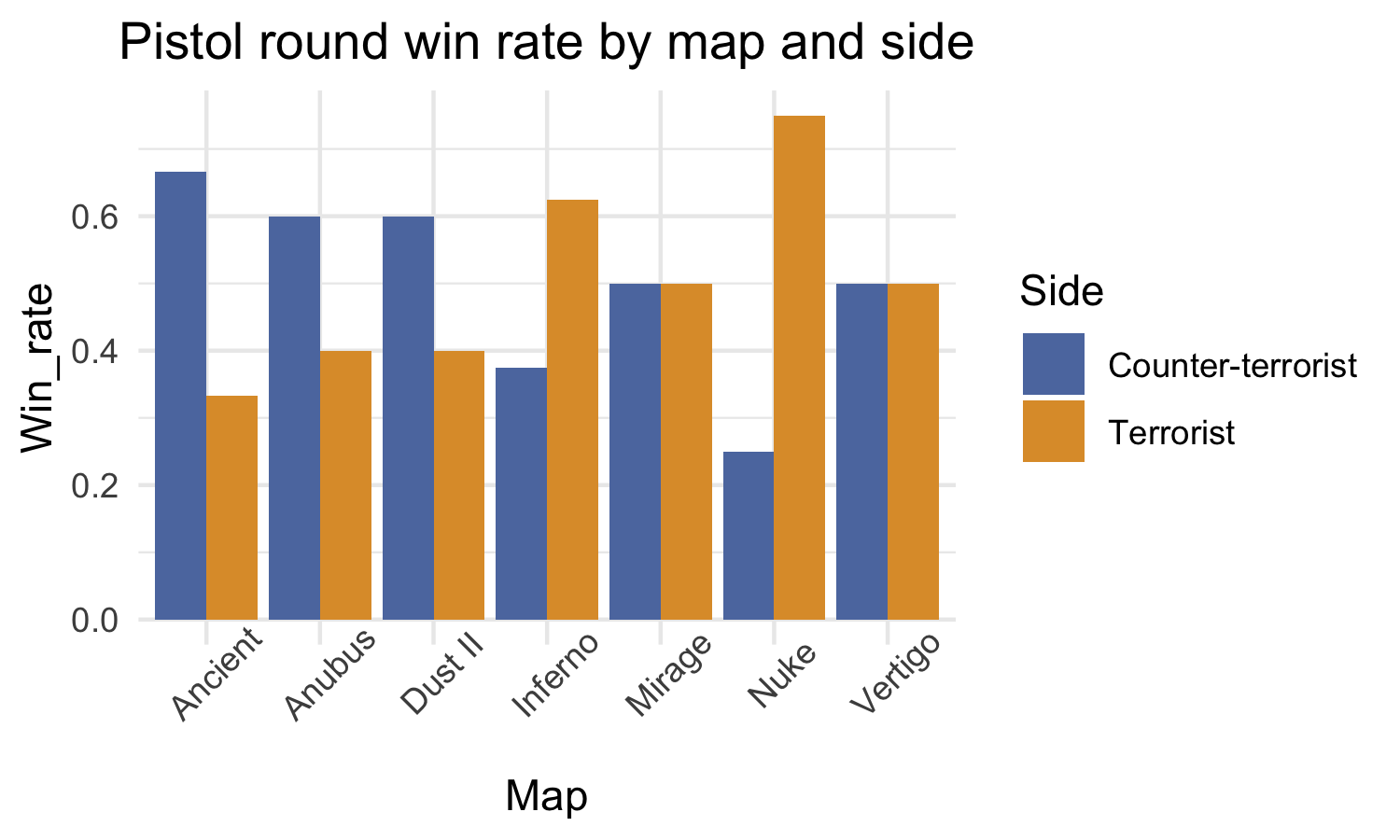
<p>Of the 64 pistol rounds, there was a perfect 32-32 split between Counter-terrorist (CT) and Terrorist (T) wins. Map picks were fairly spread (Table 1), but Mirage was by far the favorite map pick juxtaposed to Vertigo with only 2 maps played. This follows rumors Vertigo will shortly be replaced with Train in the competitive map pool. Figure 1 also shows the pistol win rate by map.</p>

<table>
  <thead>
    <tr>
      <th style="text-align: center">Mirage</th>
      <th style="text-align: center">Anubus</th>
      <th style="text-align: center">Dust II</th>
      <th style="text-align: center">Inferno</th>
      <th style="text-align: center">Nuke</th>
      <th style="text-align: center">Ancient</th>
      <th style="text-align: center">Vertigo</th>
    </tr>
  </thead>
  <tbody>
    <tr>
      <td style="text-align: center">9</td>
      <td style="text-align: center">5</td>
      <td style="text-align: center">5</td>
      <td style="text-align: center">4</td>
      <td style="text-align: center">4</td>
      <td style="text-align: center">3</td>
      <td style="text-align: center">2</td>
    </tr>
  </tbody>
</table>

<p>Table 1: Times each map was played in the 2024 Blast World Final.</p>

<p><img src="https://aeyocca.github.io/assets/images/piston_win_rate.png" alt="" />
Figure 1: Pistol round win-rate by map and team.</p>

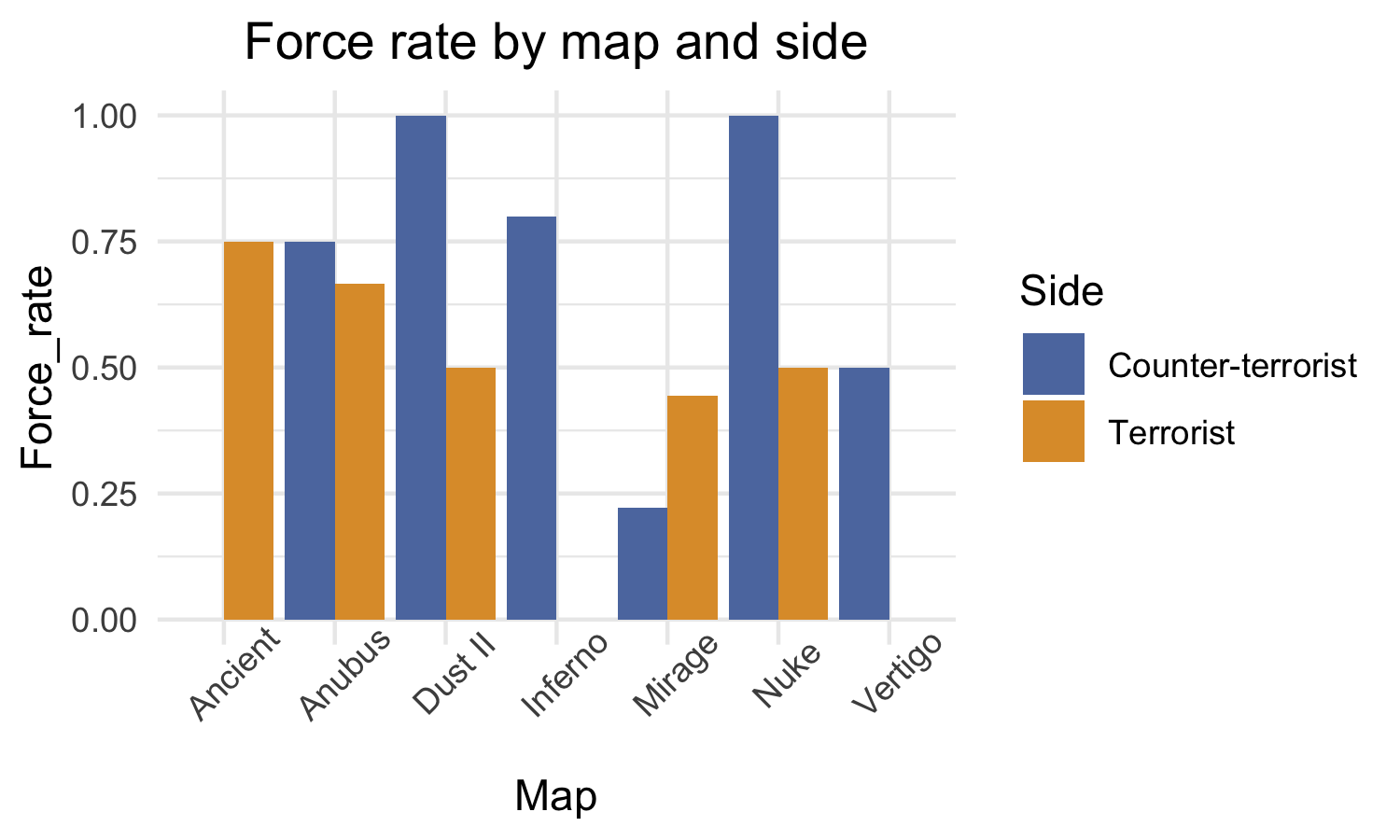
<p>Next, I checked how often the team which loses the pistol round forces. Overall, teams forced 54.69% of the time; a slight preference. The results were split across maps and sides as well as shown in Figure 2. Notably, T-side Vertigo, T-side Inferno, and CT-side Ancient never opted for a force buy after losing the pistol while CT-side Nuke and CT-side DustII always chose to force.</p>

<p><img src="https://aeyocca.github.io/assets/images/force_rate.png" alt="" />
Figure 2: 2nd round force rate by map and team</p>

<p>Let’s check the probability of winning the second round if you force vs. if you do not force. Teams saving in the second round won precisely 0% of their save rounds. More notably, the overall force win success rate was just 14%, so why force at all? We need to look at the resulting 3rd round. The thought behind saving and effectively conceding the 2nd round is to boost your chance of winning the 3rd. Teams that saved had a 50% win rate in the 3rd round while teams that forced sit at 34%.</p>

<p>The overall win rate in the 2nd and 3rd round for teams that lose the pistol is 24.6%. When deciding between forcing and saving, I consider the overall probability of victory in the next two rounds. For the sake of simplicity, lets add the probabilities of round victories given different situations. From here forward P(force) and P(save) refer to the combined probability of the next two rounds given a force or save in the 2nd round. Overall, P(save)=50% (0% + 50%) while P(force)=48% (14% + 34%). Lets check some potential co-factors however that should affect these statistics.</p>

<p>First, lets consider side. CTs forced 64.5% compared to 47% for Ts. CT’s P(save)=45%  compared to P(force)=35%, suggesting its better for the CTs to save. The values on T-side were P(save)=53% and P(force)=66% indicating a pretty decent edge for the T-side when forcing.</p>

<p>Successfully planting the bomb on T-side comes with a $300 bonus to the player planting the bomb along with $800 for their teammates in the event of a round loss. Therefore, forcing is a more tempting prospect if the bomb was planted. Across all 64 rounds, the bomb was planted 64% of the time. If the T-side did not plant the bomb, P(force)=60% and P(save)=57%. Surprisingly, a slight edge exists to force even without a plant. There was an effect of planting however. If the T-side planted the bomb in the pistol round, P(force)=70% while P(save)=33%. This value strongly suggests you plant, you buy.</p>

<p>Now its time for the boring caveats and discussion. First, the sample size is not extensive. 64 pistol rounds may seem like a lot, but when breaking down co-factors such as side and plant, one round can swing these summary statistics by several points. The most obvious caveat to take away when making your own decisions in game is these are top-tier professionals. Their decision-making and subsequent outcomes have little bearing on my own gameplay at least since they’re effectively playing a different game than we are. I think pro player’s effectiveness with the Desert Eagle epitomizes this point. At only $700 and with a one-shot headshot potential, this weapon is highly effective in the hands of someone that can actually aim and frequently flips round outcomes at the pro level in save and force buy scenarios. Another factor I failed to consider was the game situation. I hypothesize teams are more likely to force buy in the second half when trailing greatly and conversely more likely to save when leading. Although there were 64 pistol rounds, I was missing data for the 2nd and 3rd rounds of the Liquid vs. G2 opening game where G2 was 13-0’d then went on to win the whole damn thing. This analysis convinced me to try and save more on CT while following the “you plant, you buy” adage more often, but the correct answer 100% of the time to give you an advantage is simply buy with your team.</p>]]></content><author><name>Alan E. Yocca, PhD</name><email>aeyap42@gmail.com</email></author><summary type="html"><![CDATA[Blast World Final save meta]]></summary></entry><entry><title type="html">What’s A Pangenome</title><link href="https://aeyocca.github.io/What's-a-pangenome/" rel="alternate" type="text/html" title="What’s A Pangenome" /><published>2020-10-14T00:00:00+00:00</published><updated>2020-10-14T00:00:00+00:00</updated><id>https://aeyocca.github.io/What&apos;s-a-pangenome</id><content type="html" xml:base="https://aeyocca.github.io/What&apos;s-a-pangenome/"><![CDATA[<p>#What the hell is a pangenome?</p>

<p>I recently set out to compare various plant pangenomes. What differences or similarities do we find between plant pangenome studies? One large confounding factor that could result in the differences between these pangenomes is their definition. At what phylogenetic distance are the members of the pangenome? Are the differences I observe a display of differences between plant lineages, or a result of differences in the size of the magnifying lens we use to investigate and construct pangenomes?</p>

<p>A naive attempt to define a pangenome is a group of organisms capable of exchanging genetic material. That definition has several issues, the first of which is it being a definition for a biological phenomenon. There are more exceptions than rules in biology, rendering definitions context specific and extremely fragile. Instead of pandering over a definition, let’s consider why one is necessary. I want pangenomes in separate plant lineages that are comparable in the sense I can attribute any observed differences to biological variation between the two groups rather than confounding methodologies used to construct the two pangenomes.</p>

<p>Its possible there do not exist such comparable lineages (though perhaps they could be created in vitro). Often I see researchers describe their study organisms as “optimal systems” to address their questions. I will rant about that in another post.</p>

<p>I guess I have to accept there will be observed differences due to the differences in pangenome definitions. But I don’t want to work hard. Why can’t it be easier than that? Is it possible to identify the differences that variations in pangenome definition cause? For example, let’s say in pangenome A, 50% of genes are core while in pangenome B, 20% are core. Can we say the individuals in pangenome B are more diverse? Almost certainly, but why are they more diverse? Is it because pangenome A is made from 50 potato plants from the same species found in Columbia (Solanum tuberosum species level pangenome) while pangenome B is made from 25 potatoes in Ireland and 25 tomatoes in Columbia (eg. the Solanum genus level pangenome). This appears to be a case of methodology accounting for these differences.</p>

<p>But what if pangenome A is the same, but pangenome B is 50 tomatoes in Columbia and we see the same differences in the proportion of core genes? Does this mean tomatoes are more diverse than potatoes? Why do I even care? Also, what the hell is divergence time or diversification rate?</p>

<p>We do our best to select the most diverse individuals of a population (representative of “diversity clusters”) to construct a pangenome. A main goal of pangenomic studies is to simply “see whats there”. That’s quite the simplification for it. There is merit in “seeing whats there”. I think the true power of pangenomic studies now is how we will use them in the future. We’re in the middle of a sequencing revolution (exaggerated?). Similar to how computation power has increased the last 50 years, we are in the upswing of increasing genomic sequencing volume and accuracy. Pangenome studies will increase in frequency and the more we do now, the better we will get at them. Additionally, these preliminary plant pangenomes can show us evidence of what we might want to focus on in future studies.</p>]]></content><author><name>Alan E. Yocca, PhD</name><email>aeyap42@gmail.com</email></author><summary type="html"><![CDATA[#What the hell is a pangenome?]]></summary></entry><entry><title type="html">Testing!</title><link href="https://aeyocca.github.io/test/" rel="alternate" type="text/html" title="Testing!" /><published>2020-08-21T00:00:00+00:00</published><updated>2020-08-21T00:00:00+00:00</updated><id>https://aeyocca.github.io/test</id><content type="html" xml:base="https://aeyocca.github.io/test/"><![CDATA[<p>gobbledy gook</p>]]></content><author><name>Alan E. Yocca, PhD</name><email>aeyap42@gmail.com</email></author><summary type="html"><![CDATA[gobbledy gook]]></summary></entry><entry><title type="html">Welcome to the ramblings of a procrasinator!</title><link href="https://aeyocca.github.io/Hello-World/" rel="alternate" type="text/html" title="Welcome to the ramblings of a procrasinator!" /><published>2020-07-30T00:00:00+00:00</published><updated>2020-07-30T00:00:00+00:00</updated><id>https://aeyocca.github.io/Hello-World</id><content type="html" xml:base="https://aeyocca.github.io/Hello-World/"><![CDATA[<p>This platform is almost exclusively intended for me to waste time (and practice writing I guess..)</p>]]></content><author><name>Alan E. Yocca, PhD</name><email>aeyap42@gmail.com</email></author><summary type="html"><![CDATA[This platform is almost exclusively intended for me to waste time (and practice writing I guess..)]]></summary></entry><entry><title type="html">NFL Covid Prediction</title><link href="https://aeyocca.github.io/NFL_COVID_pred/" rel="alternate" type="text/html" title="NFL Covid Prediction" /><published>2020-07-30T00:00:00+00:00</published><updated>2020-07-30T00:00:00+00:00</updated><id>https://aeyocca.github.io/NFL_COVID_pred</id><content type="html" xml:base="https://aeyocca.github.io/NFL_COVID_pred/"><![CDATA[<h1 id="nfl-covid-prediction">NFL Covid Prediction</h1>
<p>#Not finished writing until August 6th where the number of COVID list occupants and opt outs has changed, but we are sticking with analysis of numbers as of July 30th</p>

<p>What will the upcoming 2020 NFL season look like?</p>

<p>I will present current Covid-19 data from the NFL and work out what I think this season will look like based on these numbers.</p>

<p>DISCLAIMER: I am not a virologist, medical doctor, epidemiologist, or any other expert in the realm of this infectious disease.
I am not taking a political stance (though I would like to).
I am not advocating for or against the occurence of an NFL season in 2020.
These are just the ramblings of a procrastinator that wants some thoughts recorded to revisit in six months to see what I got right.</p>

<p>I address a few main questions:</p>
<ul>
  <li>How will Covid-19 affect the quality of NFL games?</li>
  <li>Whats the likelihood of all 256 games being played?</li>
</ul>

<p>How will Covid-19 affect the quality of NFL games?
Overall, I predict Covid-19 will cause starters to miss games in every single NFL game this year.</p>

<ul>
  <li>
    <p>Opt outs
https://www.cbssports.com/nfl/news/nfl-team-by-team-opt-out-tracker-damien-williams-nate-solder-among-players-who-will-pass-on-2020-season/
32</p>
  </li>
  <li>
    <p>test results for first wave of testing
https://nfltraderumors.co/2020-nfl-covid-19-list/
As of 07-30-2020 there are 69 players on the reserve/Covid-19 list</p>
  </li>
</ul>

<p>The virus will likely spread within teams. Therefore, it is improper to extrapolate these on a per team basis. Extrapolation will conservatively estimate a worst case scenario so I am comfortable doing so.</p>

<p>I will assume these numbers will be steady throughout the season, again being conservative. Every team will miss 2-3 players per game due to Covid-19.</p>

<p>Compare this to Football Outsider’s Adjusted Games Lost (AGL) metric for perspective. Teams averaged 75 AGL in the 2019 season. If every team loses 2-3 players per game, they will add over 30 AGL to this metric. Imagine a 50% increase in the injury rate of your favorite team. Now imagine this affecting the entire roster instead of the occasional special teams contributor.</p>

<p>Any football fan can imagine what life is like without their starting quarterback (<em>cough</em> Steelers, Jets, Panthers <em>cough</em>). Whats the probability a starting QB misses a game due to Covid-19? As the virus take about two weeks to pass, an infected QB is likely to miss two games at least.</p>

<p>Lets say each team has a static 53 man roster, resulting in 1696 players. If 70 have the virus at any given week (assuming each player gets counted twice before coming off the list), I project 595 players to have contracted Covid-19 be the end of the season. Wow. I didn’t calculate this number until just now. That’s pretty bleak. 
The probability at least one QB will contract Covid-19 is the complement of the probability no QB contracts Covid-19.</p>

<p>P(Your QB avoids the COVID list) = 0.65
P(No QB lands no the COVID list) = 1 - (0.65)^32 = 1.03092 x 10^-6</p>

<p>If I am a betting man, I guarantee at least a single starting QB will miss a game because of COVID (given the above assumptions which are likely incorrect)</p>

<p>#hyperlink AGL metric here: https://www.footballoutsiders.com/stat-analysis/2020/2019-adjusted-games-lost-part-i</p>

<p>The Texans and Chiefs reported earlier than any other team, as their first game occurs four days before any other. After the first round of testing, few players have been added to their COVID reserve lists. Perhaps the structure of an NFL team has reduced risky behavior. May that trend extend to other teams? We will find out shortly.</p>

<p>Whats the likelihood of all 256 games being played? How many players must be sick to cancel a game? This number is likely high. Major League Baseball has cancelled several games due to positive COVID tests. However, MLB has the option to schedule double headers later in their season. NFL players oppose Thursday Night Football games for the lack of recovery time between Sunday and Thursday. Even if four days is the absolute minimum between games, the season must be extended to account for cancelled games. I predict the regular season will either end before all 32 teams have played 16 games, or it will be extended before playoffs begin.</p>

<p>It will be fun to revisit these predictions in September.</p>]]></content><author><name>Alan E. Yocca, PhD</name><email>aeyap42@gmail.com</email></author><summary type="html"><![CDATA[NFL Covid Prediction #Not finished writing until August 6th where the number of COVID list occupants and opt outs has changed, but we are sticking with analysis of numbers as of July 30th]]></summary></entry></feed>